


Posted on June 17 2026
Canada Eases Work Permit Rules for Provincial Nominee Applicants. Apply Now!

By , Editor & Director
Updated June 17 2026
Highlights: Canada Expands Work Permit Support for Provincial Nominee Candidates
- Canada has introduced temporary work permit measures for eligible Provincial Nominee Program applicants awaiting permanent residence status.
- The new temporary measures will be effective from June 9, 2026, and will remain operative until December 31, 2026.
- PNP applicants in Canada can now use alternative proof of PR application submission if they have not yet received an Acknowledgement of Receipt (AOR).
- Eligible spouses of Provincial Nominee applicants can also benefit from expanded access to open work permits.
- Canada is set to help PNP applicants maintain their work authorization amid longer permanent residence processing timelines.
*Wondering if you qualify for Canada Provincial Nomination Program? Use Y-Axis CRS Score Calculator and PR Eligibility Points Calculator to assess your profile.
Provincial Nominee Applicants in Canada to Get Easier Access to Work Permits
Canada has introduced temporary measures to help eligible PNP applicants maintain their work authorization while awaiting decisions on their Canada permanent residence (PR) applications. The changes are designed to address delays caused by extended processing timelines for application completeness checks.
The new measures will be effective from June 9, 2026, to December 31, 2026, providing greater flexibility for applicants and their eligible spouses under the Provincial Nomination Program.
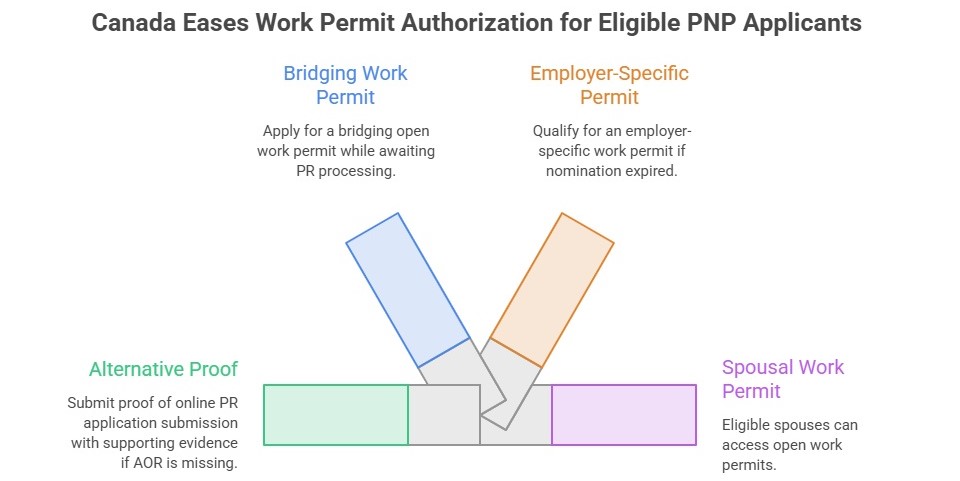
| Key Measure | Details |
|---|---|
| Alternative proof accepted | Applicants without an Acknowledgement of Receipt (AOR) can submit proof of online PR application submission along with supporting evidence. |
| Bridging Open Work Permits | Eligible PNP applicants can apply for bridging open work permits while awaiting PR processing. |
| Employer-Specific Work Permits | Certain applicants with expired nominations may qualify for employer-specific work permits. |
| Spousal Work Permits | Eligible spouses of PNP applicants can access open work permits under the temporary measures. |
| Validity Period | From June 9, 2026, to December 31, 2026. |
| Purpose | Helps applicants avoid losing work authorization due to delays in PR application processing. |
Also, read...
Canada Updates Processing Times for Express Entry and Provincial Nominee Programs. Apply Now!
How Will This Benefit PNP Applicants?
The temporary measures provide greater certainty for Provincial Nominee Program applicants who are waiting for their permanent residence applications to be processed. By accepting alternative proof of application submission, Canada is helping eligible candidates maintain their legal work status even if they have not yet received an Acknowledgement of Receipt (AOR).
Here is how the temporary measures for Canada work permit will benefit existing PNP candidates:
- Reduced risk of losing work authorization while awaiting PR processing.
- Greater flexibility through acceptance of alternative application proof.
- Continued access to employment opportunities in Canada.
- Open work permit options for eligible spouses.
- Improved stability for applicants facing longer processing timelines.
- Smoother transition from temporary status to permanent residence.
*Are you looking for step-by-step assistance with Canada immigration? Contact Y-Axis, the world's No. 1 overseas immigration consultancy.
For recent Canadian immigration updates, check out the Y-Axis Canada Immigration News Page.
FAQs
What is Canada's new work permit measure for PNP applicants?
Canada has introduced temporary measures that allow eligible Provincial Nominee Program (PNP) applicants to access work permits more easily while waiting for their permanent residence applications to be processed. The policy aims to address delays in the issuance of Acknowledgement of Receipt (AOR) letters. Under the new rules, certain applicants can use alternative proof that they have submitted a permanent residence application. The measures also benefit eligible spouses and are intended to help applicants maintain their legal status and employment authorization in Canada during the PR processing period.
When did the new temporary measures come into effect?
The temporary measures came into effect on June 9, 2026. According to Immigration, Refugees and Citizenship Canada (IRCC), the policy will remain in place until December 31, 2026. During this period, eligible PNP applicants and their spouses can take advantage of the relaxed documentation requirements for work permit applications. The initiative is designed to provide temporary relief to applicants affected by processing delays and long wait times for permanent residence application completeness checks. Applicants should ensure they meet all eligibility requirements before submitting a work permit application.
Who is eligible under the new work permit policy?
The measures apply to certain Provincial Nominee Program applicants who have submitted permanent residence applications and are awaiting processing. Eligible individuals may include those applying for bridging open work permits, employer-specific work permits linked to expired nominations, and spouses who qualify for open work permits. Eligibility depends on meeting IRCC requirements and providing acceptable supporting documentation. Applicants should review the latest guidance from IRCC to determine whether they qualify under the temporary measures and what documents must be submitted with their work permit application.
What if I have not received an Acknowledgement of Receipt (AOR)?
Applicants who have not yet received an Acknowledgement of Receipt (AOR) may still be able to apply for a qualifying work permit under the temporary measures. Instead of an AOR, they can submit proof that their permanent residence application was filed online, along with supporting documentation requested by IRCC. This flexibility helps applicants avoid delays caused by lengthy completeness checks. However, applicants must ensure that all submitted documents are accurate and meet the requirements outlined by Canadian immigration authorities for the specific work permit category.
Can I use alternative proof if I already have an AOR?
No. Applicants who have already received an Acknowledgement of Receipt must continue to provide the AOR when applying for a qualifying work permit. The alternative proof option is intended only for applicants who are still waiting for the AOR due to processing delays. IRCC has clarified that the standard documentation requirements remain unchanged for individuals who already possess this document. Providing the correct documentation can help prevent delays in processing and ensure that the work permit application is assessed under the appropriate eligibility criteria.
How do these measures help PNP applicants?
The temporary measures help PNP applicants maintain legal work authorization while waiting for permanent residence processing. Without these provisions, some applicants could face employment disruptions if they are unable to secure a new work permit before receiving an AOR. By accepting alternative proof of application submission, Canada is providing greater flexibility and reducing uncertainty. The policy supports workers, employers, and families by allowing eligible applicants to continue working and contributing to the Canadian economy while their immigration applications are under review.
Are spouses of PNP applicants included in the new policy?
Yes. Eligible spouses of Provincial Nominee Program applicants may also benefit from the temporary measures. Depending on their circumstances, they may qualify for open work permits that allow them to work for most employers in Canada. This provision helps families maintain financial stability while waiting for permanent residence decisions. Spouses must still meet all applicable eligibility requirements and submit the necessary supporting documents. The inclusion of spouses reflects Canada's effort to support immigrant families during extended immigration processing timelines.
What types of work permits are covered under the new measures?
The temporary measures cover several work permit categories, including Provincial Nominee Program bridging open work permits and certain employer-specific work permits linked to expired nominations. Eligible spouses may also apply for open work permits. These options are designed to help applicants remain employed while waiting for a decision on their permanent residence applications. The specific work permit available will depend on the applicant's circumstances, nomination status, and compliance with IRCC requirements. Applicants should carefully review eligibility criteria before applying.
Why did Canada introduce these temporary measures?
IRCC introduced the temporary measures in response to delays in conducting completeness checks for permanent residence applications. These delays have resulted in longer waiting periods for applicants to receive their Acknowledgement of Receipt. Without intervention, some applicants risked losing their ability to work legally in Canada while awaiting immigration decisions. The policy provides a practical solution by allowing alternative proof of application submission and expanding work permit access. The objective is to reduce disruptions for workers and employers during the processing period.
Will these measures affect permanent residence processing?
📞 Call: +91-7670800000
📩 Email: info@y-axis.com
🌐 Visit: https://www.y-axis.com
Tags:
Canada PNP
Provincial Nomination Program
Canada work permit
Canada work visa
work in Canada
Canada PR
Canada permanent residence
Canada immigration news
migrate to Canada
Canada immigration
Share
Options for you by Y-Axis

Get it on your mobile

Get News alerts

Contact Y-Axis
Latest Article
Related Post
Trending Article
Posted On June 17 2026
Canada Eases Work Permit Rules for Provincial Nominee Applicants. Apply Now!